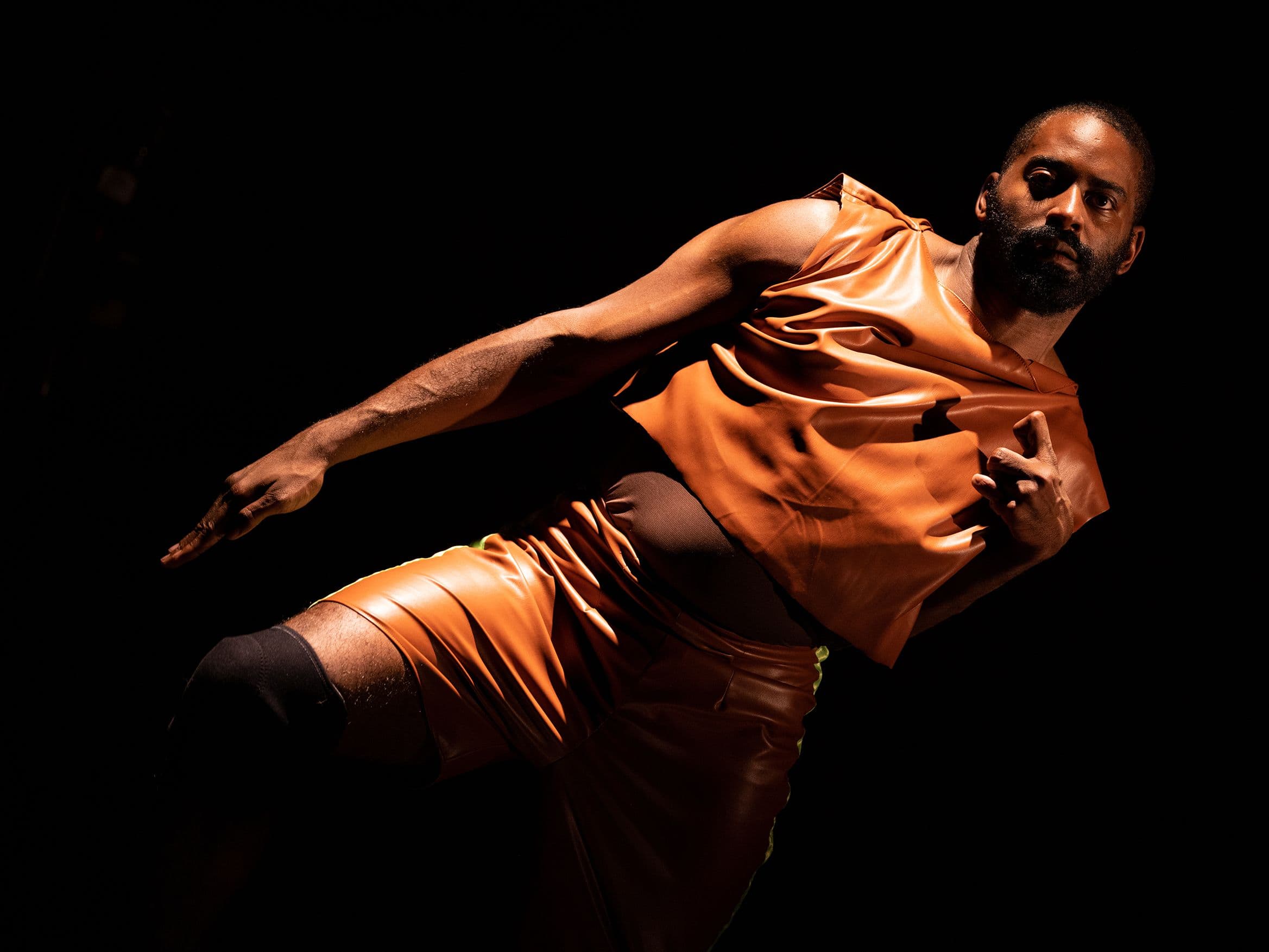
Jerron Herman is a celebrated artist, choreographer, and director who has choreographed, written, and performed numerous works that center images of freedom and disabled perspectives, bringing his own lived experience as a dancer with cerebral palsy into prominent artistic spaces.
Recently selected as the National Dance Institute’s 2025-2026 Artist in Residence, Herman is also the choreographer and co-director of Sensorium Ex, a new opera that explores what it means for non-verbal artists to have a voice. He’s developed a speaking series for the Joyce Theater called Discourse: Disabled Artists at the Joyce, bringing together NYC-based artists with disabilities to showcase their work in 2021. He is also part of INTERIM, a boutique consortium focusing on joy for artists with disabilities.
Herman has premiered works at Danspace Project and Performance Space New York, and produced responsive installations at The Whitney, The Metropolitan Museum of Art, Cooper Hewitt Design Museum, and The Guggenheim. Herman has received fellowships from United States Artists, NYU/Center for Ballet, Foundation for Contemporary Arts, The Jerome Foundation, among others. In 2020, Herman was awarded the Disability Futures Fellowship from the Ford Foundation and the Andrew W. Mellon Foundation.
When you were a kid, did you always dream about becoming a dancer?
I came from a creative family. My older brother was an actor in high school and college. I really worshipped his way of being on the stage. I started writing as a way to be a part of the arts because no one was checking for me to be a performer, so I thought I could do it from the background. I started writing plays and writing text and drama and that’s how I got into the arts. I came to New York as a writer and that’s how I got started. So, dance was not on my radar.
Can you share your college experience?
The school I went to had no arts programs and was very heavily centered on a classic liberal arts curriculum. I was doing a lot of interning around New York City. I became an education apprentice at the New Victory Theatre my rising junior year. I met a choreographer there named Seán Curran, who introduced me to Heidi Latsky. He got an audition for me to audition with Heidi. That’s how I got started. I thought it could be a cool antidote, to dance for a summer, to have an experience like that. Then, it became a career.
What was the experience at Heidi Latsky Dance Company?
When I joined, it was kind of a new era for the company and we expanded during my era there. The disability arts movement was really taking off as well. It felt that there was a lot going on. I was learning a lot about myself and that’s when I started to feel more confident about being a full-time artist, while being a part of the company.
Being selected as the National Dance Institute’s 2025-2026 Artist in Residence, what do you hope to achieve?
It feels very impactful, because I get to evolve as a choreographer and to set more work on more people. This will be a new commission, a new piece that I am creating. To do it on top of young people with/without disabilities feels very kindred to how I got started. I’m really excited to get more opportunities to build on top of my creativity and to also start to push the cannon a little bit too. Not only will I have a new piece in my repertoire, but National Dance Institute (NDI) will have its first piece by a disabled choreographer in its physically integrated youth company.
What is DREAM (Dancers Realize Excellence Through Arts and Movement) and its connection to the National Dance Institute?
The DREAM project is a peer-to-peer dance program for children with/without disabilities that is led by Kay Gayner and Agnes McConlogue Ferro. It seeks to establish pathways for collaboration and movement knowledge for different bodies for multiple folks with the emphasis on the integration of disabled people. They do that through an innovative approach to partnering with a similar age group. The disabled youth that come into the program have non-disabled peer participants that share the same choreography. DREAM really supports NDI’s mission that the arts are an integral part of any child’s education. Similarly, the relationship to disability is something that shouldn’t be shied away from and shouldn’t be thought of as a deficit.
How do you see this fellowship advancing your artistry and career?
Personally, it allows me to push my voice. Choreographing for young people is a skill I have not mastered yet. It will be really interesting to work with young people with my choreography. It also expands my own status as a choreographer, increasing my repertoire.
I get to repair a part of my childhood and my younger self and tell him that he was always a part of this arts game and this industry. I get to encourage young people with disabilities to think about a pathway into the arts and be an example of professionalism.
For your artist in residence term what sort of projects are you working on?
I have a commission to choreograph a new piece. I’m choreographing a new piece for the NDI youth company participants. I’m also thinking about introducing a professional development program for the teaching artist at NDI to integrate disability and think about disability more dynamically. That looks like me teaching my work from my career to the other teaching artists as well as being available to support NDI this year. Kay and I will be a part of a conference for NDEO (National Dance Educators Organization). We are doing a module workshop/webinar. I also get opportunities to use the NDI space for other artistic actions and desires. Overall, I’m a supporter of the organization in various ways.
How does your family feel about the new avenue you have taken for your career?
My parents were healthfully skeptical about what this would look like. Every parent who engages with their child who says they want to be an artist, there will be some logistical questions about how to do that. On top of that, how can I, as a person with cerebral palsy, also sustain? I’ve taken them along the ride with me. My parents have actually been my costume designers for a couple of my pieces. So, they have been able to come with me, soup to nuts on how to put on a production and specifically, one of my productions. They have seen them on tour. In 2024, I got to tour my piece VITRUVIAN in Baltimore, at the Baltimore Museum of Art, my mom’s hometown. I’m originally from the Bay Area, so I also took the same piece to San Francisco. My brother is also really supportive, and I think at this point they are marveling at, how do you get all this done?
What is your dream goal for your career?
My big dream is that I keep working. Consistency and sustainability are way more important to me than a big award. Early in my career, I was very fortunate to have received the typical awards and fellowships you get for being in the arts world, which have been a surprise. I have been awarded fellowships and other awards that are not only for people working in the disability space, which makes me believe my work has resonance with mainstream dance culture.
Do you feel that it is difficult to get taken seriously, when there are people in society who don’t respect those with disabilities in the dance world?
I don’t put the insecurity or the society insecurity of what I am supposed to do or how I am supposed to look, on stage. Art is the idea of closely looking at something. I just take the time to closely look at something, such as how I move. It’s interesting how my arm moves or stays static. It’s interesting how my leg moves or stays static. Or, how I walk, how my gait is. I’ve just made that into an artistic image. I think there’s a little bit of education that happens where I am teaching others how to see me or how to view me, how to view someone with cerebral palsy—and that’s what my work has served to do. I try to give audiences new imagery to take on and move from the theatre to their own lives—with the hope that when they interact with someone on the street or in real life that they will have a different mentality around it.
To learn more about Jerron Herman, visit his website.
FUN FACT: A photo of Jerron Herman performing is part of the exhibition at the new Museum of Disability History at The Viscardi Center.