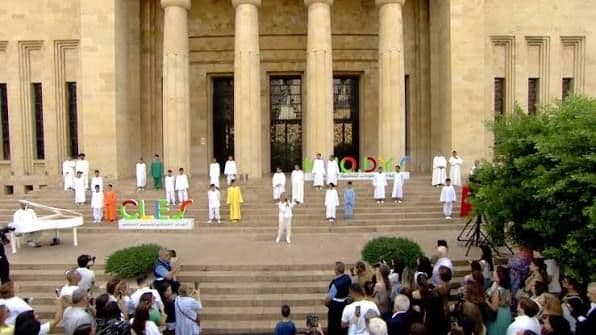
BEIRUT, October 10, 2026 — With dance, theater and music, the Lebanese Center for Special Education (CLES) transformed the steps of Beirut’s National Museum into an open-air stage on Saturday afternoon, marking the 12th edition of 10.10.DYS, Specific Learning Difficulties Awareness Day. Outside the building that preserves Lebanon’s memory, the future took center stage: theatrical monologues told the story of learning difficulties and live music accompanied a speech by Carmen Chahine Debbane, founder and president of CLES.
The performance carried a message beyond celebration. Specific learning difficulties, from dyslexia, dysgraphia and dyscalculia to language, motor coordination and attention disorders, are invisible and do not stem from low intelligence. Yet CLES estimates that they affect up to one in five students, often leaving the children who face them at the back of the classroom. At a venue of such symbolic significance, CLES sought to bring these difficulties into the open and to reaffirm that early diagnosis and specialized support, both provided free of charge since its founding, can change the entire course of a child’s life.
The children and the Dance by CLES team performed the dance pieces. Launched by CLES in 2017 in partnership with New York’s National Dance Institute, the program brings dance into public and private schools, uniting children of different learning abilities. By rehearsing and performing together, they develop discipline, teamwork, self-confidence, and a sense of belonging.
The monologues were the work of the team behind the awareness-raising play Shou Bene Mama? (What’s Wrong with Me, Mom?), whose title captures the question of a child who does not understand why they are struggling. The play explores four of these difficulties and has been performed at more than 130 public and private schools and public libraries since 2012.
Music had its moment, too: a violin performance by one of the winners of Let’s Music, the competition CLES organized in 2022 with Virgin Radio Lebanon, along with singing and qanun playing by two young artists. Specialists from CLES centers who support children through diagnostic and therapy sessions also took part in the performance. On the museum steps, these artistic initiatives, launched by CLES over the years, came together in a production drawn entirely from its own programs and talent. After 11 years of conferences, TV shows and films, this year’s event brought 10.10.DYS to the steps of the National Museum.
Carmen Chahine Debbane explained that CLES had chosen this day “to remind people that every child has the right to learn, whatever their difficulties,” before sketching a portrait of the children CLES works with:
“There are children who see and write letters and words differently.
There are children whose thoughts come all at once, making it hard to sort through them and focus.
There are children whose words do not express their thoughts.
And there are children who struggle to understand quantities and arithmetic.
These children are not less. They are different.”
She summed up the center’s mission: “No child should be left on the sidelines, and no child should have to face their difficulty alone. It is our responsibility to help every child reach their fullest potential, whatever that potential may be. When we teach our children to understand difference, toaccept it and to respect it, we are not only building a better school; we are building a fairer society and a nation closer to peace.”
She concluded: “Peace does not begin simply when wars end. Peace begins with education. It begins with our children. And our children… are the world.”
–––
About CLES
The Lebanese Center for Special Education (CLES) is a Lebanese nonprofit, nongovernmental and nonsectarian organization founded by Carmen Chahine Debbane on March 8, 1999, to provide free, individualized support to children with specific learning difficulties, from diagnosis to therapy. Its 100 specialists and professionals work across eight centers: Sodeco and Badaro in Beirut, Tripoli, Saida, Zouk, Zahle, Nabatieh, and Semkanieh. CLES conducted about 10,000 diagnostic assessments and provided one-to-one therapy to around 2,000 children. In collaboration with the Ministry of Education and Higher Education, it has also equipped learning-support rooms in 104 public schools.